ArogyaSutra: A Multi-Agent Framework for Multimodal Medical Reasoning in Indic Languages
An actor–critic system combining tool-based visual grounding and dual-memory mechanisms for step-wise, error-aware clinical reasoning across 7 Indian languages.
Multimodal Large Language Models (MLLMs) have shown promising capabilities in general domains, yet their performance remains limited in specialized healthcare settings — particularly for multilingual and low-resource scenarios. In regions like rural India, patients express complex medical queries in native Indic languages and rely on multimodal inputs such as medical images. Existing MLLMs, predominantly trained on English-centric data, fail to serve these communities.
We introduce ArogyaBodha, a large-scale multilingual multimodal medical QA dataset of 40,857 expert-verified samples from 8 heterogeneous sources, covering 31 body systems, 6 imaging modalities, and 21 clinical domains across English and 7 major Indian languages. We further propose ArogyaSutra, an actor–critic multi-agent framework combining tool-based visual grounding with dual-memory mechanisms for step-wise, error-aware decision making. Experiments demonstrate consistent improvements over strong baselines across all evaluated Indic languages.
40,857
Total QA samples
8
Languages
31
Body systems
21
Clinical domains
+9.2
pts over base model
50.4%
OOD accuracy
Contributions
What We Introduce
This work makes four key contributions to multilingual medical AI and low-resource NLP.
ArogyaBodha Dataset
40,857 samples across English + 7 Indic languages, curated from 8 medical sources with expert verification and COMET-QA quality control.
ArogyaSutra Framework
An actor–critic multi-agent system with tool-grounded visual reasoning, code-switching, and dual short/long-term memory for iterative correction.
Fine-tuned MLLM
arogyasutraV1E3.5 — Qwen2.5-VL-7B distilled from actor–critic rollouts, achieving 43.40% avg and 50.4% OOD accuracy.
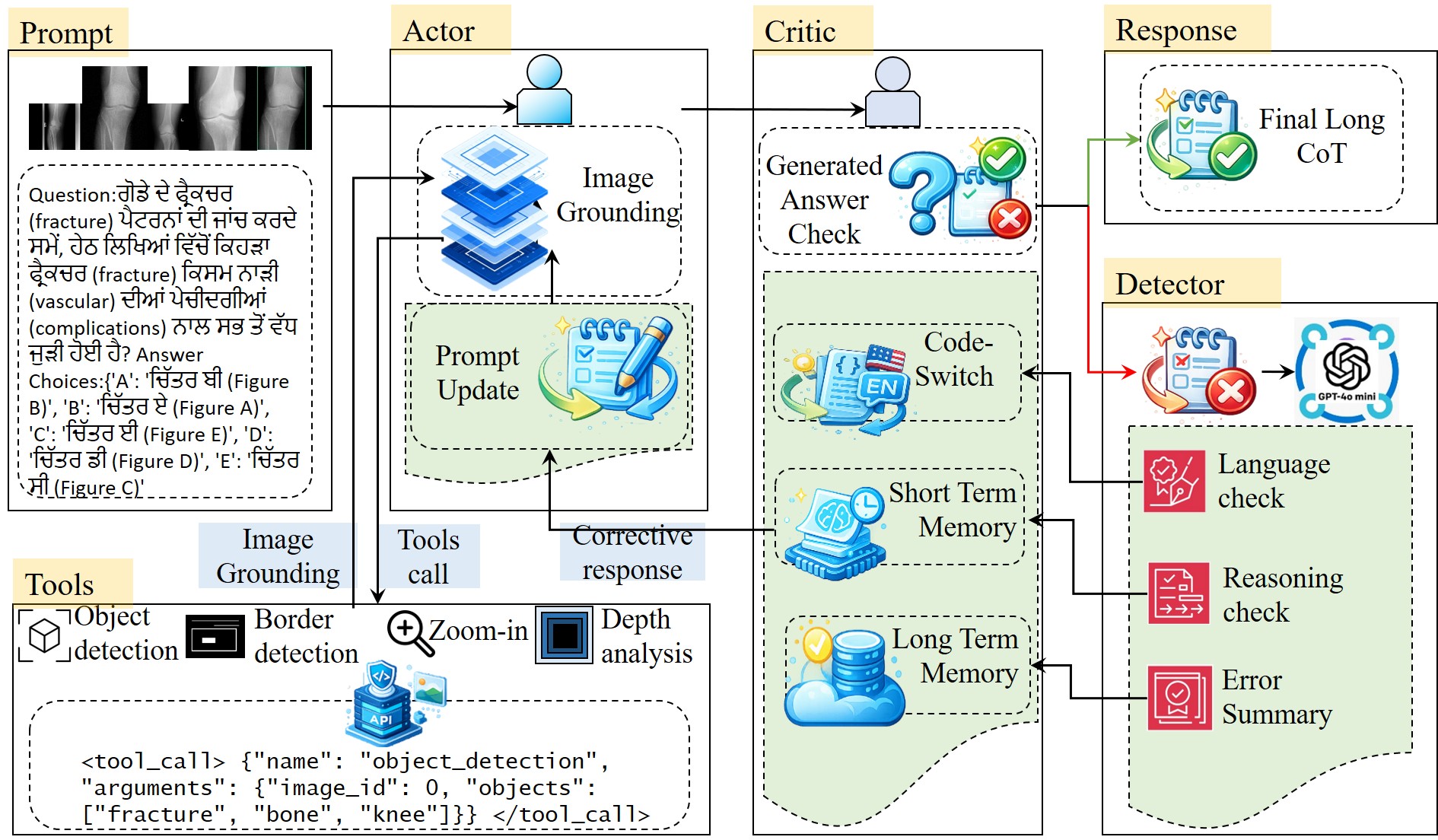
Overview of the ArogyaSutra framework. The Actor processes medical images via vision tools and generates step-wise reasoning. The Critic evaluates outputs, triggering code-switching for language errors or memory-guided reflection for reasoning errors, and iteratively refines the Actor's response.
Framework
ArogyaSutra: Actor–Critic with Memory & Tools
Both the Actor and Critic share the Qwen2.5-VL-7B backbone but differ in role. The Actor generates step-wise reasoning augmented by vision tools; the Critic evaluates correctness and triggers targeted feedback. After training, only the distilled Actor is used at inference — no Critic needed.
1
Actor — tool-grounded reasoning
Processes the medical image and Indic-language query, invoking four vision tools (object detection, zoom/crop, edge detection, depth estimation) to extract clinically relevant evidence before generating step-by-step reasoning.
2
Critic — evaluate & diagnose
Scores the Actor's output (ŝ ∈ [0,1]). If correct, outputs the final long CoT answer. If incorrect, an error detector (GPT-4o-mini) classifies the failure as a language error or a reasoning error.
3
Language error → code-switch to English
If the failure stems from linguistic instability (repetition, incomplete output), the Critic provides corrective feedback in English to stabilize the Actor's generation.
4
Reasoning error → memory-guided reflection
If the failure is logical, feedback is issued in the original Indic language, drawing on short-term memory (most recent error) and long-term memory (summarized error history) to prevent repeated mistakes.
5
Distillation — inference without Critic
Critic-approved traces are distilled into the Actor via supervised fine-tuning. At inference, the Actor predicts directly from state + memory, eliminating Critic overhead entirely.
Results
Performance
Zero-shot evaluation on 130 samples per language (910 total). Metric: choice accuracy. ArogyaSutra (7B) surpasses GPT-4.0 by +4.1 pts and its own base model by +9.2 pts.
Model
AS
BN
HI
MR
PB
TA
TE
Avg
GPT-4.0
38.40
44.60
40.10
37.80
39.20
36.90
39.10
39.30
Mistral-Small-3.2-24B
40.90
42.90
44.10
43.20
40.90
41.40
42.50
42.27
MedGemma-4B-it
38.50
35.10
37.40
34.50
35.70
36.70
34.90
36.11
MedVLM-R1
23.50
22.80
25.60
22.80
24.20
25.40
22.20
23.79
Qwen2.5-VL-7B (base)
32.30
36.50
33.84
36.12
32.30
35.38
33.07
34.21
ArogyaSutra (7B)
47.69
45.38
42.30
42.30
43.07
41.53
41.53
43.40
AS = Assamese · BN = Bengali · HI = Hindi · MR = Marathi · PB = Punjabi · TA = Tamil · TE = Telugu
Out-of-Distribution Performance
Evaluated on 100 private real-world clinical queries collected by practicing physicians. ArogyaSutra achieves the highest accuracy, demonstrating strong generalization under distribution shift.
Model
OOD Accuracy
Qwen2.5-VL-7B (base)
35.0
MedGemma-4B-it
45.2
ArogyaSutra (7B)
50.4
Ablation Study
Component Analysis
Removing image grounding or code-switching causes the steepest accuracy drops (−16.5 pts each). Memory alone improves over no-memory by +3.7 pts but reaches peak performance only when combined with grounding.
Component ablation (avg accuracy)
Full ArogyaSutra
43.40
w/o Critic & Image Grounding
33.43
w/o Critic
33.71
w/o Image Grounding
26.86
w/o Code-switching
26.86
Image grounding × memory
Grounding
Memory
Avg
✗
✓
26.86
✓
✗
30.57
✓
✓
43.40
Qualitative Evaluation
Qualitative Analysis
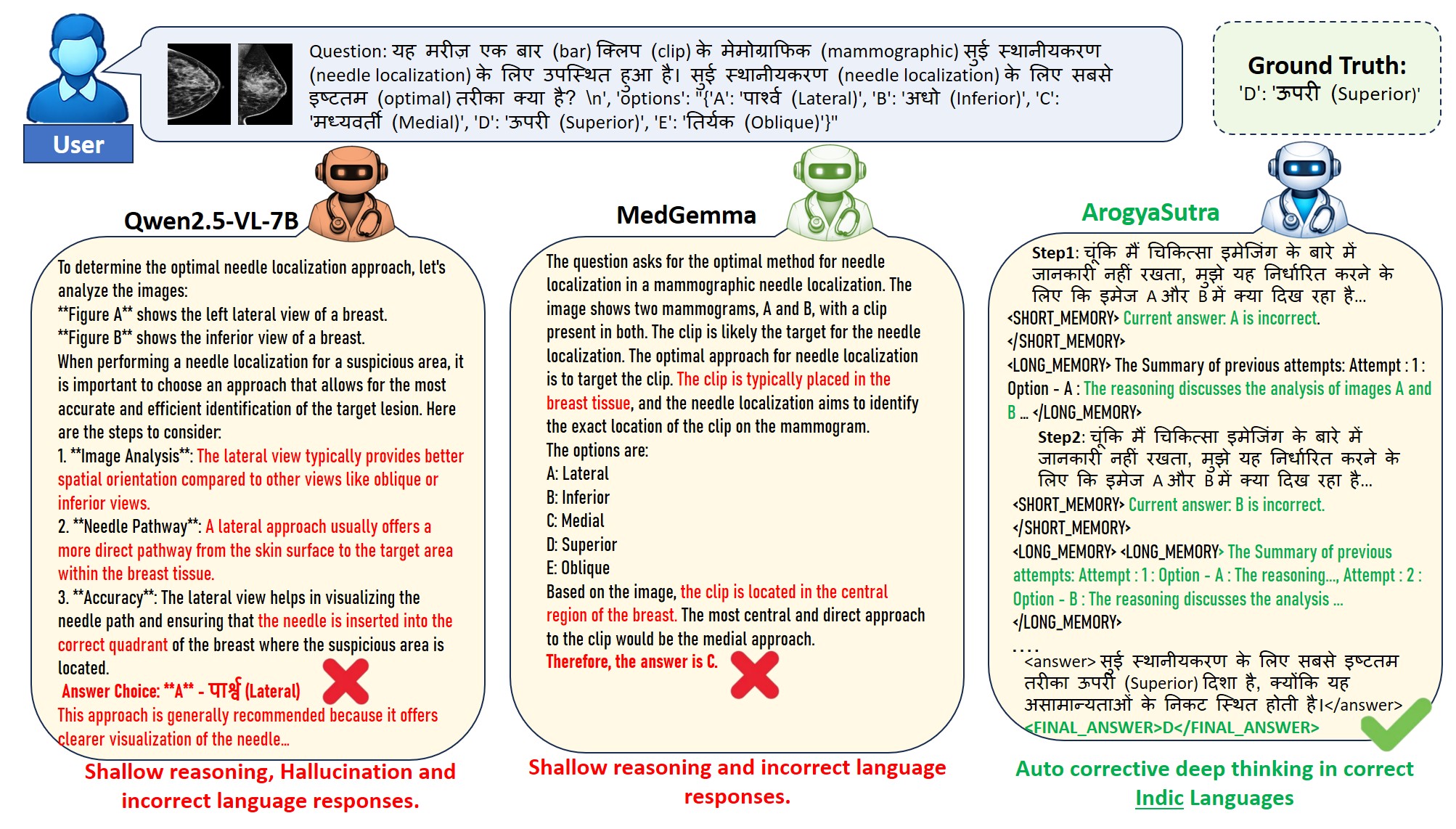
ArogyaSutra consistently generates responses in the target Indic language and demonstrates more structured and corrective reasoning compared to baselines. Leveraging the actor–critic framework, the model identifies and revises incorrect intermediate conclusions, progressively eliminating implausible hypotheses — highlighting its effectiveness in improving multilingual alignment and reasoning fidelity.
Qualitative comparison of ArogyaSutra against MedGemma-4B-it and Qwen2.5-VL-7B-Instruct baselines. Correct clinical tokens are highlighted in green; incorrect or adversarially altered tokens in red.
Citation
BibTeX
@inproceedings{halder2026arogyasutra,
  title     = {ArogyaSutra: A Multi-Agent Framework for
               Multimodal Medical Reasoning in Indic Languages},
  author    = {Halder, Tanmoy Kanti and Ghosh, Akash and
               Baidya, Subhadip and Roy, Arijit and Saha, Sriparna},
  booktitle = {Proceedings of the Thirty-Fifth International Joint
               Conference on Artificial Intelligence (IJCAI)},
  year      = {2026},
  url       = {https://github.com/IITP-CSE/ArogyaSutra}
}